Chicken breast vs turkey breast calories: protein, fat and the better pick
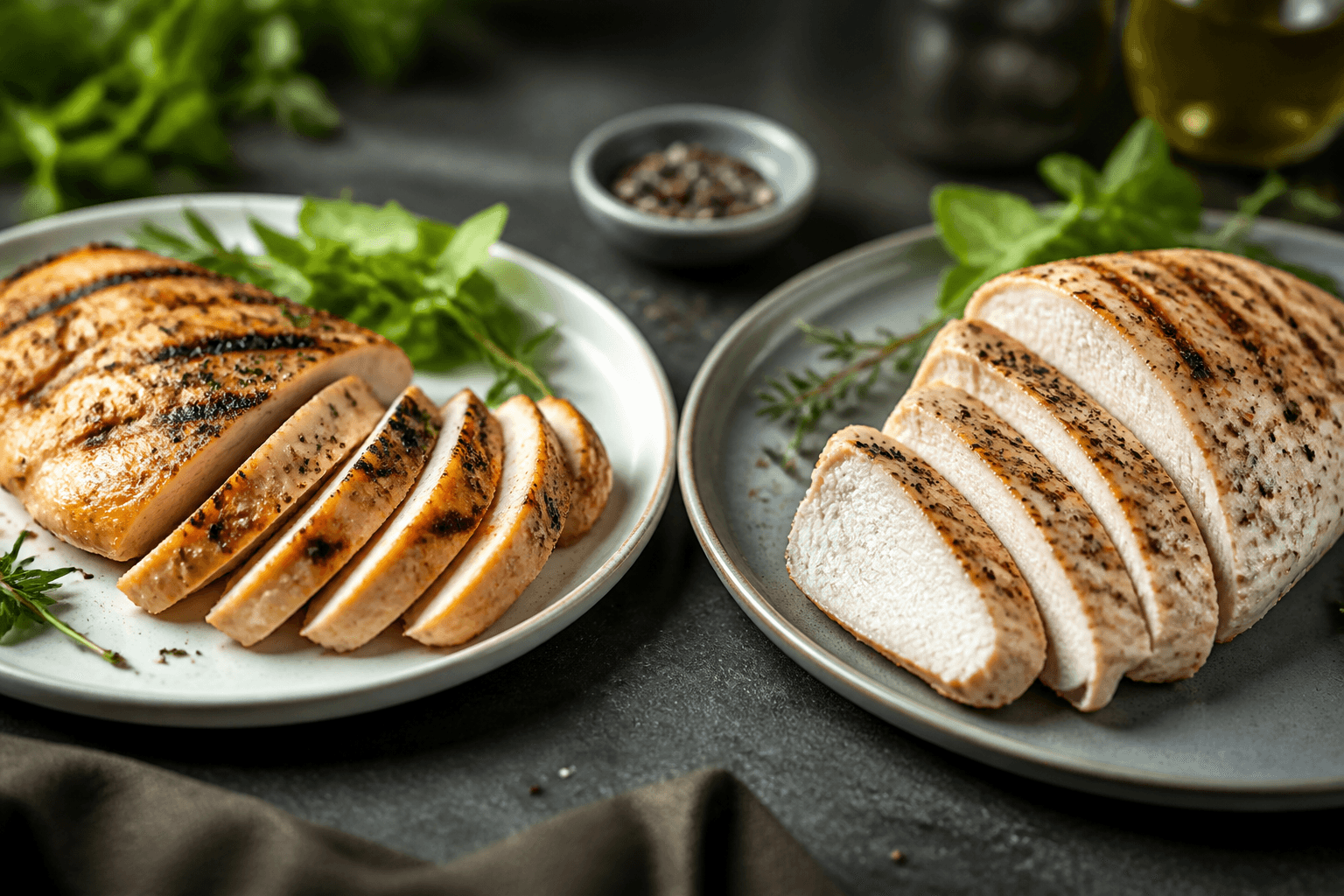
Chicken breast has **165 kcal per 100 g** and turkey breast has **135 kcal per 100 g**. Turkey also has less fat, while protein stays almost the same.
Published Nov 13, 20267 min read
In this guide
Turkey breast is lower in calories and fat, while chicken breast is slightly higher in protein per 100 g. This article is about the Cal AI app by BeeStudio (calai.me), not the other app with the same name.
Which has fewer calories and more protein per 100 g?
Turkey breast comes out lower on calories. Per 100 g, cooked chicken breast has 165 kcal, 31 g protein, 0 g carbs, and 3.6 g fat ; cooked turkey breast has 135 kcal, 30 g protein, 0 g carbs, and 1 g fat . For protein, they are close. For calories, turkey is lower by 30 kcal per 100 g . For fat, turkey is lower by 2.6 g per 100 g .
That fat gap is the part many comparisons skip. It helps explain why turkey reads leaner even though the protein number is almost the same. If you are choosing by protein per calorie, turkey has the edge because it gives nearly the same protein with fewer calories .
| Food | Portion | Grams | kcal | Protein | Carbs | Fat |
|---|---|---|---|---|---|---|
| Chicken breast, cooked | 100 g | 100 g | 165 kcal | 31 g | 0 g | 3.6 g |
| Turkey breast, cooked | 100 g | 100 g | 135 kcal | 30 g | 0 g | 1 g |
That is about 8.3% of a 2,000 kcal day for chicken breast and 6.8% for turkey breast .
If you want the clearest shorthand: chicken gives slightly more protein per 100 g, turkey gives fewer calories and less fat. The difference is small on protein, but it is real on calories.
Chicken breast vs turkey breast calories for a typical portion
The Cal AI catalog gives a common cooked chicken breast serving as 1 small breast = 120 g = 198 kcal . For turkey breast, the catalog serving is 3 oz sliced = 85 g = 115 kcal . Those are the portion sizes people actually eat and log, so they are the useful numbers when you are deciding what to enter.
| Food | Portion | Grams | kcal | Protein | Carbs | Fat |
|---|---|---|---|---|---|---|
| Chicken breast, cooked | 100 g | 100 g | 165 kcal | 31 g | 0 g | 3.6 g |
| Chicken breast, cooked | Small breast | 120 g | 198 kcal | 37.2 g | 0 g | 4.32 g |
| Chicken breast, cooked | Large example | 180 g | 297 kcal | 55.8 g | 0 g | 6.48 g |
| Turkey breast, cooked | 100 g | 100 g | 135 kcal | 30 g | 0 g | 1 g |
| Turkey breast, cooked | 3 oz sliced | 85 g | 115 kcal | 25.5 g | 0 g | 0.85 g |
| Turkey breast, cooked | Large example | 170 g | 230 kcal | 51 g | 0 g | 1.7 g |
That is about 9.9% of a 2,000 kcal day for a 120 g chicken breast, 5.8% for an 85 g turkey breast, 14.9% for a 180 g chicken breast, and 11.5% for a 170 g turkey breast .
The cleanest way to compare portions is to hold grams constant. At 120 g, chicken breast is 198 kcal and turkey breast would be 162 kcal if you used the 100 g value and multiplied by 1.2 . At 170 g, chicken breast would be 281 kcal and turkey breast would be 230 kcal . The gap grows as the serving gets bigger.
If you are eating mixed prepared food, do not try to force the plate into a perfect database match. Use the closest breast entry, then fix the grams to match what is actually on the plate. That matters more than choosing a label that looks perfect but does not fit the meal.
Which is the better pick for your goal?
If your goal is lower calories, turkey breast is the cleaner pick . It gives you the same general lean-protein profile with fewer calories per 100 g and less fat . That is useful when the rest of the plate already has rice, sauce, oil, or cheese and you want the protein part to stay light.
If your goal is more protein without changing the meal much, chicken breast is slightly higher in protein per 100 g . The difference is small, though. In practical terms, both are solid choices when you want a high-protein main with no carbs .
If satiety is your main concern, chicken can still work well because it has a bit more fat . That does not make it a different food category; it just means the meal may feel a little richer. Turkey is the better lean option when you want the plate to stay as light as possible.
For convenience, choose the food you can portion accurately. A sliced turkey portion is often easier to weigh in a deli-style meal. A whole cooked chicken breast is often easier to identify as a single piece on the plate. The best choice is the one you can log with less guesswork.
How we compared these foods
The comparison used the Cal AI catalog entries for cooked chicken breast and cooked turkey breast, plus the catalog serving sizes listed for each item . The per-100 g values were checked by hand against the catalog entries and the portion numbers were calculated directly from those values .
The app side matters because most users are logging prepared meals, not plain raw ingredients. Cal AI estimates calories and macros from a meal photo, offers recognition variants to choose from, and lets you edit grams and calories . In the catalog, the median estimate across 914 Cal AI photos of prepared meals from 247 people is 342 kcal per serving . Packaged products make up 19% of food photos; the rest are prepared meals .
How do you log chicken or turkey breast in Cal AI?
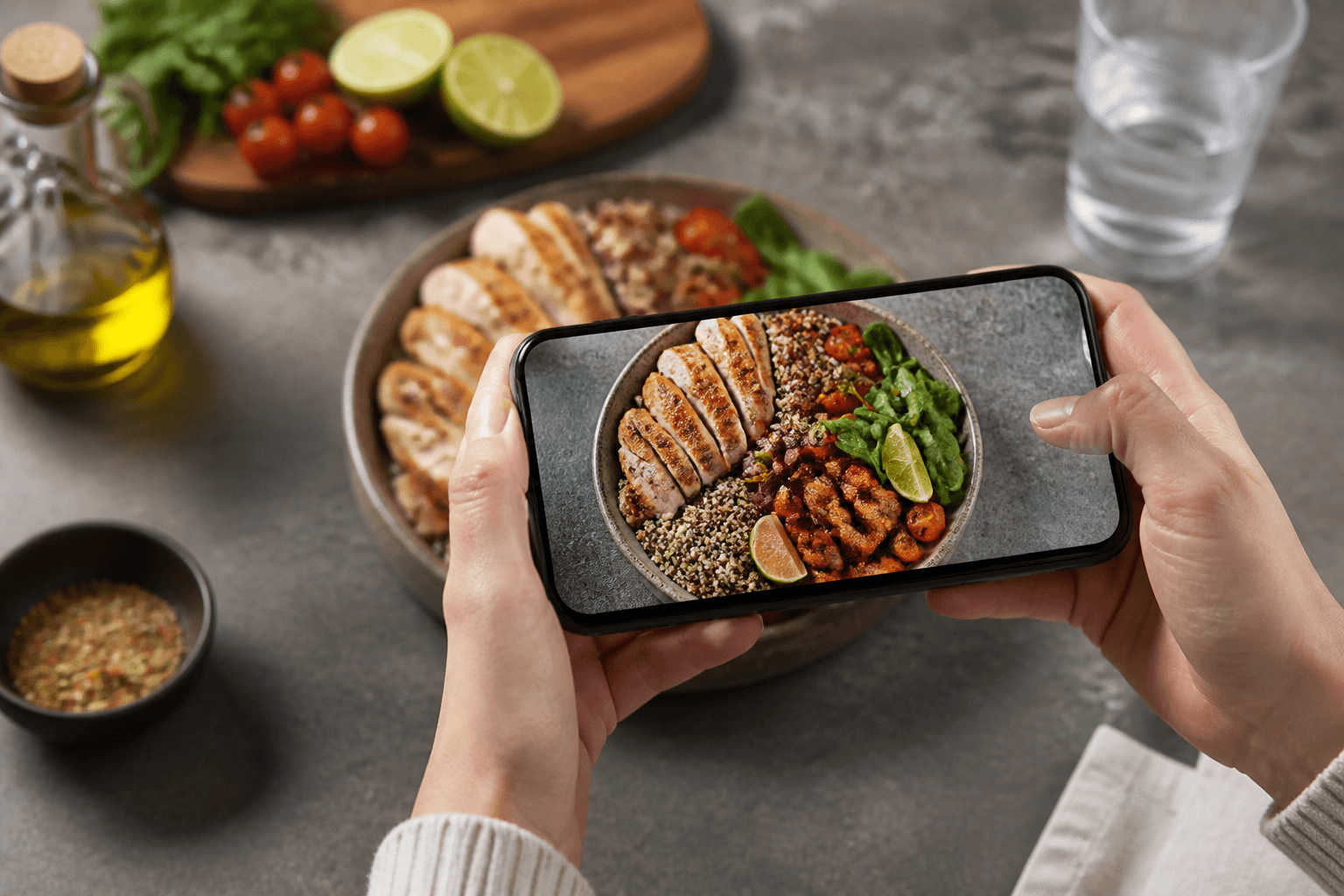
Take the photo first, then pick the closest recognition variant, then correct the grams if the plate is bigger or smaller than the guess. That is the flow the app is built for: photo scan, a choice between recognition variants, and editable grams or calories .
For a plain breast on a plate, the closest match is usually simple. For a mixed meal, be more careful. If the chicken or turkey comes with sauce, vegetables, rice, or breading, scan the whole plate, pick the closest variant, then adjust the grams for the meat part rather than trusting the first estimate.
If you do not want to scan, use manual entry instead . That works for a meal you already weighed, and it avoids the guesswork of matching a photo to the wrong cut. The app also keeps day-by-day history and a daily calorie goal based on TDEE using the Mifflin-St Jeor formula .
For breast meat specifically, the simplest logging habit is this: weigh the cooked portion once when possible, then reuse that gram value when the same meal comes back. If your plate has sauce or added oil, log that separately when you can so the meat entry stays clean.
FAQ: common chicken breast vs turkey breast questions
Is turkey breast always lower in calories than chicken breast?
In this comparison, yes . Turkey breast is 135 kcal per 100 g and chicken breast is 165 kcal per 100 g . The difference comes from the lower fat number on turkey breast .
Which has more protein per calorie?
Turkey breast does, by a small margin . It has almost the same protein as chicken breast but fewer calories, so the protein-to-calorie ratio is better.
Should I log cooked or raw weight?
Use the form that matches the catalog entry you are choosing. If the app item is for cooked breast, match your cooked portion to that cooked entry and keep the grams consistent with what is on the plate.
What if my chicken or turkey breast is part of a sandwich or bowl?
Log the mixed meal as a whole if you can identify the full plate, then adjust the grams for the meat after the scan. That is usually more accurate than logging the protein alone and guessing the rest.
Does Cal AI have a searchable food database for this kind of logging?
No. Cal AI is built around photo scanning, recognition variants, editable grams and calories, and manual entry instead of a searchable food database . If a meal is packaged, the photo flow still works, but the gram adjustment is what makes the estimate usable.
Topics
Frequently asked questions
Which has the better protein-to-calorie ratio?
Turkey breast does, because it keeps protein almost the same while lowering calories. That makes it the leaner pick when you want the meal to stay light.
Can I use these numbers for deli slices?
Only if the deli meat is plain breast meat and close to the cooked entry you are using. Thin sliced deli meat can vary with added water, salt, or curing, so the photo plus gram adjustment matters.
Why does turkey breast look leaner even though protein is almost the same?
Because the fat number is much lower. In this comparison, that lower fat is what drives the calorie gap more than protein does.
Does Cal AI have a searchable food database for this kind of logging?
No. Cal AI uses photo scanning, recognition variants, editable grams and calories, and manual entry instead of a searchable food database.
Cal AI Editorial Team
Practical guides on nutrition, calorie tracking, meal planning, and building healthier habits with Cal AI.
Editorial policyRelated articles
- white rice
Calories in White Rice: Cup, Bowl, Restaurant Portion
Calories in white rice start at **130 kcal per 100 g**. See the cup, bowl, and restaurant portions, plus the quickest way to log rice in Cal AI.
Oct 30, 20267 min read4 views
- cal ai
Cal i: How to log a meal from a photo and what to expect
Cal AI estimates calories and macros from a meal photo, not a manual database lookup [f:cal.product.0]. Here is how to log food, what it handles well, and what to fix when the estimate is off.
Oct 29, 20268 min read
- french fries
Calories in French Fries: Small, Medium and Large Portions
French fries are 312 kcal per 100 g, and a standard 117 g serving is 365 kcal. Use grams, not size names, when the portion looks unclear.
Oct 23, 20265 min read4 views
- chicken breast
Calories in Chicken Breast: 100 g, One Breast, Grilled vs Fried
Chicken breast has 165 kcal per 100 g cooked. See one-breast calories, grilled and fried adjustments, and how to log it accurately.
Oct 17, 20266 min read3 views
- rice
White Rice vs Brown Rice Calories: Cooked Portions and Logging
Use cooked grams before judging white rice vs brown rice calories. The overall-health answer depends on the whole plate, not rice color alone.
Oct 14, 20267 min read3 views
- cal ai
Cal AI vs MyFitnessPal: Photo Scans or Database Logging?
Choose Cal AI for photo-first meal logging; choose MyFitnessPal if you need database search, integrations, recipes or weight tracking.
Oct 8, 20267 min read1 views