Calories in French Fries: Small, Medium and Large Portions
French fries are 312 kcal per 100 g, and a standard 117 g serving is 365 kcal. Use grams, not size names, when the portion looks unclear.
Published Oct 23, 20266 min read
In this guide
A standard 117 g serving of french fries has 365 kcal; 100 g has 312 kcal.
That standard serving is about 18 percent of a 2,000 kcal day: 365 ÷ 2,000 = 18.25%, rounded to about 18%. The base values below are from the Cal AI catalog entry for french fries: 312 kcal, 3.4 g protein, 41 g carbs and 15 g fat per 100 g.
How many calories are in small, standard and large french fries?
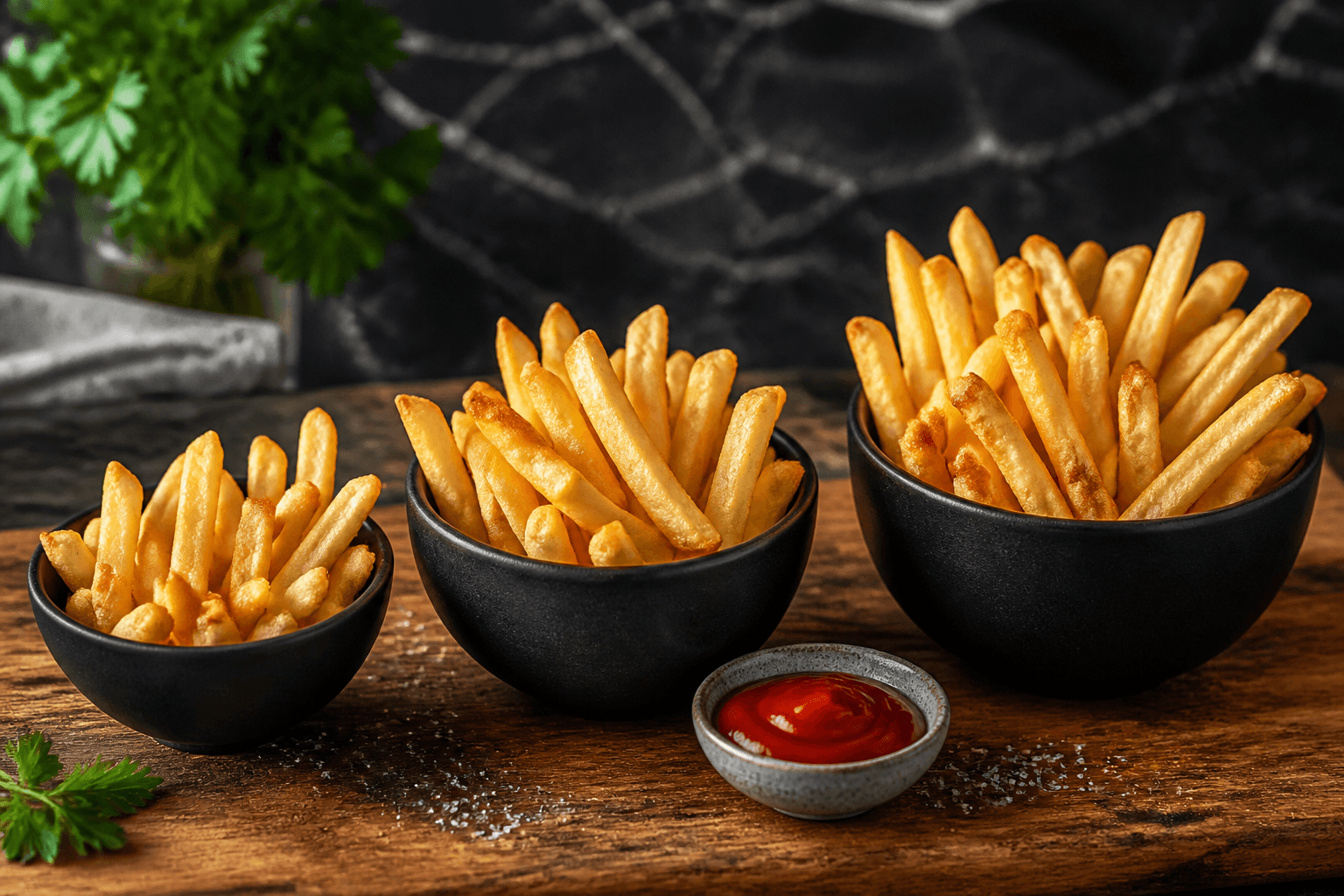
Use grams first. Size names are useful only when you have no scale or package weight, because one place can call a portion medium while another serves the same amount as small. In this guide, the standard portion is the catalog medium serving: 117 g. The small estimate is half of that serving, and the large estimate is one and a half standard servings.
| Portion | Grams | Calories | Protein | Carbs | Fat |
|---|---|---|---|---|---|
| 100 g reference | 100 g | 100 × 312 ÷ 100 = 312 kcal | 100 × 3.4 ÷ 100 = 3.4 g | 100 × 41 ÷ 100 = 41.0 g | 100 × 15 ÷ 100 = 15.0 g |
| Small, about ½ standard | 58.5 g | 58.5 × 312 ÷ 100 = 183 kcal | 58.5 × 3.4 ÷ 100 = 2.0 g | 58.5 × 41 ÷ 100 = 24.0 g | 58.5 × 15 ÷ 100 = 8.8 g |
| Standard, catalog medium serving | 117 g | 117 × 312 ÷ 100 = 365 kcal | 117 × 3.4 ÷ 100 = 4.0 g | 117 × 41 ÷ 100 = 48.0 g | 117 × 15 ÷ 100 = 17.6 g |
| Large, about 1½ standard | 175.5 g | 175.5 × 312 ÷ 100 = 548 kcal | 175.5 × 3.4 ÷ 100 = 6.0 g | 175.5 × 41 ÷ 100 = 72.0 g | 175.5 × 15 ÷ 100 = 26.3 g |
The fastest read: if your fries look like a normal medium side, log 117 g and 365 kcal. If the portion is clearly smaller, use 58.5 g and 183 kcal. If it is a heaped tray or a shareable side, 175.5 g and 548 kcal is a better starting point.
Why can two orders of french fries have different calories?
The number swings because the portion weight changes before anything else. A short paper sleeve, a carton filled to the top, and a basket for the table can all be called fries, but the grams are not the same. Since french fries are 312 kcal per 100 g, every extra gram moves the total by the same rate: grams × 312 ÷ 100.
The second reason is added fat after cooking or at serving. If fries are tossed with extra olive oil, add the oil separately: 1 tbsp olive oil is 14 g, and 14 × 884 ÷ 100 = 124 kcal. If butter is added, 1 tbsp butter is 14 g, and 14 × 717 ÷ 100 = 100 kcal. Those amounts are for the added tablespoon, not for the fries themselves.
Sauce also changes the plate. A milk-based sauce starts with whole milk at 61 kcal per 100 ml before any other ingredients are counted. If you know the sauce or dip from a package or recipe, log it as its own item. If you do not know it, keep the fries entry clean and add a separate manual estimate for the sauce rather than folding everything into the fries grams.
What should you log if the fries are already on the plate?
If you can weigh them, weigh the cooked fries and use the gram formula. For example, the catalog method is always grams × 312 ÷ 100. That keeps the estimate tied to the actual portion, not the menu label.
If you cannot weigh them, compare the plate with the standard serving. A portion that looks like about half a medium side can use the small line. A normal side can use the standard line. A larger carton, a tray, or a portion meant to share can use the large line. This is less exact than weighing, but it is better than picking a size name without checking the amount.
If some fries are left uneaten, adjust the grams down. The cleanest way is to estimate the fraction left and reduce the logged grams before saving. If half of a standard serving is left, the eaten amount is closer to the small line than the standard line.
How do you log french fries in Cal AI?
This article is about the Cal AI app published by BeeStudio at calai.me, not another app with the same name. To log fries, take a photo, choose the recognition variant that best matches the plate, then correct the grams before saving. If the app shows a close result but the portion is bigger or smaller, edit grams and calories instead of accepting the first match.
You can also use manual entry when you do not want to scan. Cal AI does not have a searchable food database, so manual entry is the route for a known package value, a receipt note, or a custom sauce. The saved entry appears in day-by-day history, and the daily calorie goal in the app is based on TDEE using the Mifflin-St Jeor formula.
How should you handle fries with toppings?
Log the fries and topping separately when the topping is visible. Plain fries use the catalog value. Added oil uses the tablespoon calculation above. Butter uses its own tablespoon calculation. A milk-based sauce can start from whole milk at 61 kcal per 100 ml only if that is the ingredient you know; otherwise, use the label or enter the sauce manually.
For cheese, gravy, loaded fries or a mixed basket, do not raise the fries grams to cover the topping. That makes the carbs, fat and protein less useful. Keep the fry weight as close as you can, then add separate entries for the extras you can identify.
Which number should you use when only the menu says small, medium or large?
Use the menu size as a clue, not as proof. If the order is described as medium and looks like a regular side, use the 117 g standard serving. If the container is shallow or only partly filled, start with the small estimate. If the fries are piled above the container or served in a tray, start with the large estimate.
When comparing fries with another food, use the same gram basis so the comparison is fair. The food comparisons section is useful for that, and the calculators page can help when you need a daily target before deciding how much room the fries take in the day.
If the meal is already eaten, save the closest gram estimate now and adjust the next time you can weigh the same order.
Topics
Frequently asked questions
Is a medium order of french fries always 117 g?
No. The 117 g amount is the Cal AI catalog medium serving, so it is a consistent logging reference. If a package, menu or scale gives you a different gram weight, use that weight.
Do the french fries calories include ketchup or dipping sauce?
No. The fries value is for french fries only. Log ketchup, dip or sauce as a separate item using the label, recipe or a manual calorie entry.
Can I use the same number for air-fried fries?
Use the gram-based fries estimate only if the cooked fries are plain and you do not have a better label value. If oil was added before or after cooking, add that oil separately.
Why do calorie apps give different numbers for french fries?
They may be using different portion weights or different assumptions about added fat. The safest check is to compare the grams first, then adjust for oil, butter or sauce.
Does Cal AI sync a fries entry to Apple Health or Google Fit?
No. Cal AI does not include Apple Health, Google Fit or fitness-tracker integration. Keep the entry in the app history, or enter it manually elsewhere if you track food in another place.
Cal AI Editorial Team
Practical guides on nutrition, calorie tracking, meal planning, and building healthier habits with Cal AI.
Editorial policyRelated articles
- chicken breast
Calories in Chicken Breast: 100 g, One Breast, Grilled vs Fried
Chicken breast has 165 kcal per 100 g cooked. See one-breast calories, grilled and fried adjustments, and how to log it accurately.
Oct 17, 20266 min read1 views
- rice
White Rice vs Brown Rice: Calories, Protein, and Which to Pick
Brown rice is slightly lower in calories than white rice, but the gap is small. Compare cooked portions, macros, and which one fits your goal at meals.
Oct 14, 20266 min read2 views
- calorie counting
Counting Calories on Holiday Without Obsessing
A practical travel logging routine for holidays: photo meals, correct portions, log beer or wine, and use day-by-day history instead of chasing perfect days.
Oct 4, 20268 min read2 views
- eggs
Calories in Egg: Boiled, Fried, Scrambled and Omelette
One large egg has 78 kcal; 2 eggs have 155 kcal and 3 eggs have 233 kcal before cooking fat. Use the table to log each portion.
Oct 1, 20266 min read1 views
- nutrition
How Many Calories Are in an Apple? An In-Depth Look
Discover the calorie content of apples, their nutritional benefits, and how they fit into a balanced diet for health-conscious consumers.
Aug 21, 20265 min read6 views
- dehydration
Dehydration Loss of Appetite: How Not Drinking Enough Can Mute Hunger Signals
Dehydration loss of appetite is more common than many people realize. Learn how fluid balance affects hunger, digestion, and practical ways to tell thirst from true appetite.
Jun 15, 20266 min read5 views