White Rice vs Brown Rice: Calories, Protein, and Which to Pick
Brown rice is slightly lower in calories than white rice, but the gap is small. Compare cooked portions, macros, and which one fits your goal at meals.
Updated Oct 22, 20266 min read2 views
In this guide
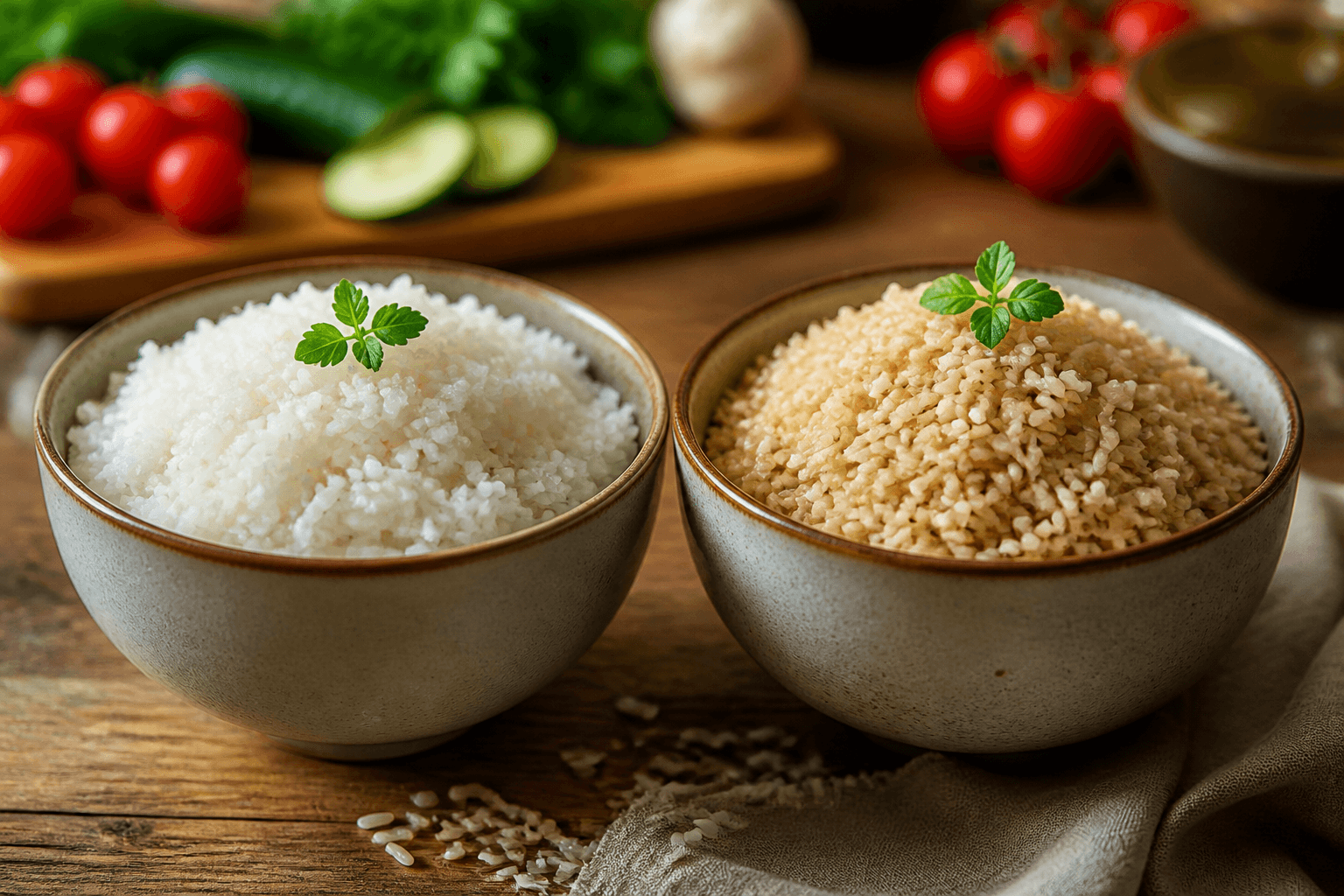
Brown rice is slightly lower: 123 kcal per 100 g versus 130 kcal per 100 g for cooked white rice, and both have 2.7 g protein per 100 g.
How many calories are in white rice vs brown rice?
The Cal AI catalog values here are for cooked rice: white rice and brown rice. The difference is small at the same cooked weight. Brown rice saves 7 kcal per 100 g, or about 10 kcal in a standard 150 g cooked cup.
Kcal are rounded to the nearest whole number. Protein, carbs, and fat are shown in grams.
| Portion | Cooked grams | White rice kcal | White rice protein | White rice carbs | White rice fat | Brown rice kcal | Brown rice protein | Brown rice carbs | Brown rice fat |
|---|---|---|---|---|---|---|---|---|---|
| 100 g | 100 g | 100 × 1.30 = 130 | 2.7 | 28 | 0.3 | 100 × 1.23 = 123 | 2.7 | 26 | 1.0 |
| Small | 75 g | 75 × 1.30 = 98 | 2.0 | 21 | 0.2 | 75 × 1.23 = 92 | 2.0 | 19.5 | 0.8 |
| Standard | 150 g | 150 × 1.30 = 195 | 4.1 | 42 | 0.5 | 150 × 1.23 = 185 | 4.1 | 39 | 1.5 |
| Large | 300 g | 300 × 1.30 = 390 | 8.1 | 84 | 0.9 | 300 × 1.23 = 369 | 8.1 | 78 | 3.0 |
A standard 150 g cup is about 10% of a 2,000 kcal day for white rice and about 9% of a 2,000 kcal day for brown rice.
Which rice is better for lower calories?
Brown rice is the lower-calorie pick at the same cooked weight. The practical difference is modest: 150 g of cooked brown rice is 185 kcal, while 150 g of cooked white rice is 195 kcal.
That means portion size usually matters more than the rice type. A 100 g portion of white rice is 130 kcal, which is lower than a 150 g portion of brown rice at 185 kcal. If your goal is to keep the meal lower in calories, weigh or estimate the cooked grams before worrying too much about the color of the rice.
For a calorie target, use the same cooked portion when comparing. If you compare 150 g brown rice with 300 g white rice, you are no longer comparing the foods; you are comparing portion sizes. If you are pregnant, have a medical condition, or have a history of an eating disorder, talk to a clinician before cutting calories.
Which rice has more protein per calorie?
Both are the same by weight for protein: 2.7 g per 100 g cooked. Brown rice is slightly better for protein per calorie only because its calorie count is a little lower.
The calculation is straightforward. White rice gives 2.7 g protein ÷ 130 kcal × 100 = about 2.1 g protein per 100 kcal. Brown rice gives 2.7 g protein ÷ 123 kcal × 100 = about 2.2 g protein per 100 kcal.
That is a small edge, not a reason to treat either rice as a main protein food. If your meal goal is higher protein, the rice choice will not do much by itself. Pick the rice you will portion accurately, then log the cooked grams.
When is white rice the better pick?
White rice is often the better pick when convenience matters. It is common in takeout, restaurants, meal prep bowls, and frozen meals, so it may be easier to match what is actually on your plate. If the dish was served as white rice, logging it as white rice is more accurate than choosing brown rice just because the calories are slightly lower.
White rice can also be the better pick if you prefer it and can keep the portion steady. The calorie gap is only 10 kcal in a standard 150 g cup. If choosing white rice helps you keep the meal simple and measured, that is usually more useful than switching to a food you will over-serve or not finish.
Use white rice when the meal is mixed with sauces or toppings and the rice type is clear. In a mixed bowl, the larger tracking error may come from the amount of rice hidden under the other ingredients, not from choosing white instead of brown.
When is brown rice the better pick?
Brown rice is the better pick when you want the slightly lower calorie option at the same cooked weight. At 300 g, the gap becomes 21 kcal: 390 kcal for white rice and 369 kcal for brown rice.
It can also be the better pick for satiety if its texture makes the meal feel more substantial to you. Satiety is personal, so test it with the same cooked grams. If 150 g of brown rice keeps you satisfied as well as 150 g of white rice, brown rice gives you the lower-calorie serving. If it does not, the calorie difference may not be worth forcing the swap.
Brown rice also has fewer carbs by weight in the Cal AI catalog: 26 g per 100 g compared with 28 g per 100 g for white rice. The gap is small, but it may matter if you are comparing two otherwise similar plates.
How should you log white or brown rice in Cal AI?
This article is about the Cal AI app published by BeeStudio at calai.me, not another app with the same name. To log rice in the app, take a photo of the plate, choose the recognition variant that matches white rice or brown rice, then correct the cooked grams if the estimate looks off.
If the photo is unclear, use manual entry instead of a scan and enter the cooked grams and calories yourself. Cal AI lets you edit grams and calories, shows a daily calorie goal from TDEE using Mifflin-St Jeor, and keeps day-by-day history. It does not include a searchable food database, weight tracking, or fitness-tracker, Apple Health, or Google Fit integration.
For a mixed plate, scan the meal first, then adjust the rice portion separately if the app groups it with other foods. If you use the site’s calculators for a daily target, keep the rice entry consistent: cooked white rice as cooked white rice, cooked brown rice as cooked brown rice.
What goes wrong when estimating rice portions?
The biggest mistake is mixing cooked and dry weights. The numbers in this comparison are cooked rice values. If you weigh rice after cooking, use these cooked entries. If you only know the dry amount, do not force it into a cooked entry unless you have the cooked weight.
The second mistake is using the bowl size as the portion. A shallow 150 g serving and a dense 300 g serving can look similar in a photo if the rice is spread out or covered. When the calorie target is tight, weigh the cooked rice once in the bowl you use most often. After that, your photo estimates and manual corrections will be closer.
The final mistake is letting toppings decide the rice entry. Sauce, oil, meat, vegetables, and other add-ons should not be folded into the rice calories. Log the rice by cooked grams, then handle the rest of the plate as separate items when you can.
Topics
Frequently asked questions
Are these calories for cooked or uncooked rice?
They are for cooked rice. If you weigh uncooked rice, use a matching uncooked entry instead of these cooked values.
Can I mix white rice and brown rice in one meal?
Yes. Log each rice by its cooked grams if you want the closest estimate, especially when the mix is not equal.
Does rinsing rice change how I should log it?
Log the final cooked rice by weight. Rinsing may change texture, but the practical tracking step is still to enter the cooked grams you ate.
Which rice is easier to estimate from a photo?
Plain rice is easier than rice covered by sauce or other foods. If it is hidden under toppings, correct the grams after the scan.
Cal AI Editorial Team
Practical guides on nutrition, calorie tracking, meal planning, and building healthier habits with Cal AI.
Editorial policyRelated articles
- french fries
Calories in French Fries: Small, Medium and Large Portions
French fries are 312 kcal per 100 g, and a standard 117 g serving is 365 kcal. Use grams, not size names, when the portion looks unclear.
Oct 23, 20266 min read
- chicken breast
Calories in Chicken Breast: 100 g, One Breast, Grilled vs Fried
Chicken breast has 165 kcal per 100 g cooked. See one-breast calories, grilled and fried adjustments, and how to log it accurately.
Oct 17, 20266 min read1 views
- eggs
Calories in Egg: Boiled, Fried, Scrambled and Omelette
One large egg has 78 kcal; 2 eggs have 155 kcal and 3 eggs have 233 kcal before cooking fat. Use the table to log each portion.
Oct 1, 20266 min read1 views
- nutrition
How Many Calories Are in an Apple? An In-Depth Look
Discover the calorie content of apples, their nutritional benefits, and how they fit into a balanced diet for health-conscious consumers.
Aug 21, 20265 min read6 views
- dehydration
Dehydration Loss of Appetite: How Not Drinking Enough Can Mute Hunger Signals
Dehydration loss of appetite is more common than many people realize. Learn how fluid balance affects hunger, digestion, and practical ways to tell thirst from true appetite.
Jun 15, 20266 min read5 views
- burger calories
How Many Calories Are in a Burger? A Practical Guide to calories in burger Counts
Burger calories can swing wildly depending on patty size, cheese, sauces, and bun choice. Learn the typical calories in burger meals and how to estimate them fast.
Jun 14, 20267 min read18 views